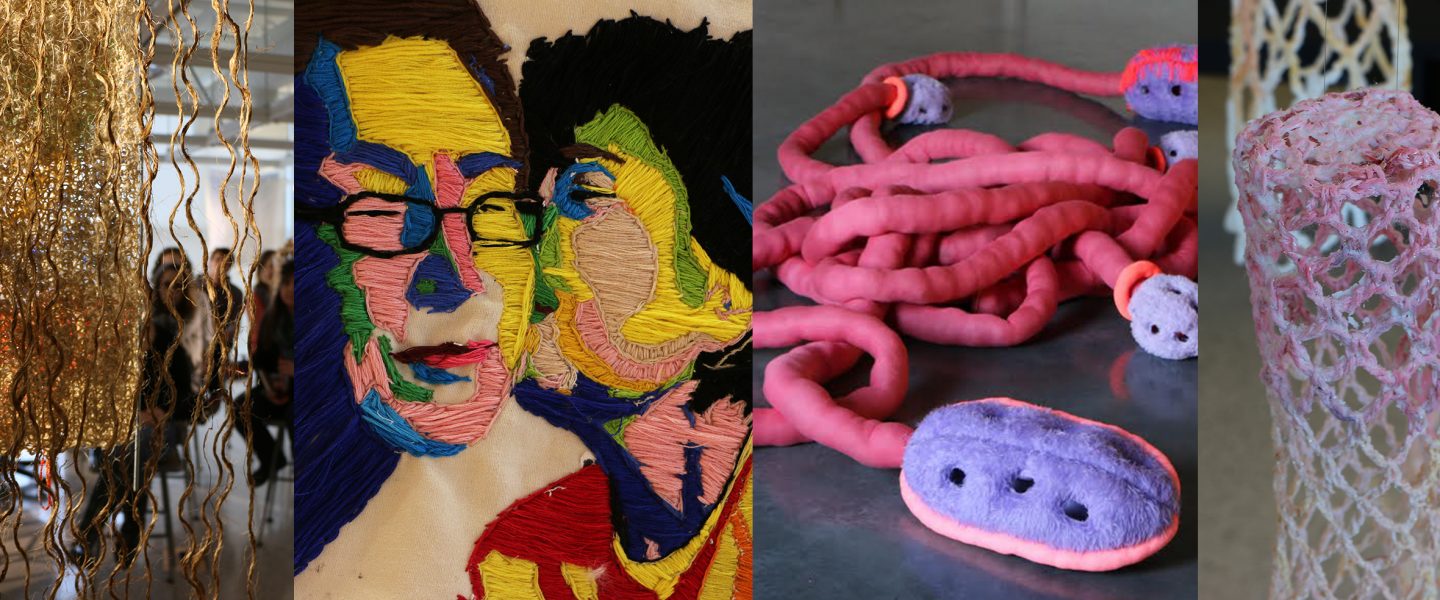

Cayewah Easley is Professor of art, Fibers Department at Savannah College of art and Design in Savannah, Ga. MFA Fiber, Cranbrook Academy of Art, Bloom eld Hills, MI l BS Environmental Design, University of California Davis, Davis, CA (emphasis in Textile Arts) SELECTED EXHIBITIONS 2005
on the bias, Starland Center of Contemporary Art, Savannah, GA l 2005 Palpable, Starland Center
of Contemporary Art, Savannah, GA l 2005 Cranbrook in Atlanta, Krause Gallery, Atlanta, GA l 2003Making Our Mark, Red Gallery, Savannah, GA l 2002 Fiber Celebration, Lincoln Center, Fort Collins, COl Meditation and the Creative Arts, Diego River Gallery, San Francisco, CA l 1997 Zozobra: Obras en Fibre de Cayewah Easley, X Galeria de Arte, Valdivia, Chile l 1995 New Work from Cranbrook, J. Wilson Center Gallery, Washington, DC l Intersections/Interstices: A Collaborative Project in Pontiac, Pontiac,MI PUBLICATIONS Architecture of Fear, Nan Ellin, ed., Princeton Architectural Press, New York, NY,


Even, and perhaps especially, as a kid, I had to answer a long string of questions before I could start any art endeavor. My father wanted to know my intentions to make sure I was ready to work. Not only did I have to sweep and organize the workspace, but I also had to explain, and justify, the purpose of the materials, thecontent and the end-use. On occasion
I would try to sneak materials or tools in order to avoid the delay from the seemingly endless, pointless interrogation so that I could “enjoy myself.” My father was quick to catch me, however, and would reward me with a lesson on the proper use of a tool, or the importance of a scrap of wood. I realize now, of course, that my father not only had incredible experience, integrity and an understanding of the entire art-making process but also endless patience and expectations that challenged me to work awfully hard. I learned that preparation, and honesty, saved me time and heartache in the end. I also learned to work toward a balance between intuitive creating and the conscious, rigorous inquiry and re ection that pushes work forward in a way that promotes growth and exchange. I am ever grateful for those lessons, which I use daily as a teacher and a maker.
To balance teaching and making is another endeavor that requires preparation, patienceand honesty. The bees and sheep seriesbegan as a re ection on teaching and learning through the use of two materials that oppose, and complement, each other: wool and wax. The molten wax is methodically applied around the wool and fused to the layer beneath with a heat gun. The wool must be protected from the heat in order not to burn. The size, quantity, and placement of the wool, in turn, determine how the wax must be applied which mediates the quality and texture of the overall surface. This mediation is the balance I seek as a maker.
- B.S., University of California, Davis
- M.F.A., Cranbrook Academy of Art
Professor, Chair, fibers Savannah College of Art and Design www.scad.edu

 NAFTAE