
David Brackett got his MFA in textiles, with honors, in 1990 from the University of Kansas. He attended the University of Michigan from 1979 to 1985, where he studied weaving and fabric design, and art history. Bracket has a bachelor in zoology from the University of Michigan (1977).
Before joining KU in 2002, Brackett was an assistant professor at the Clarion University of Pennsylvania. He also taught at the University of North Texas, Skidmore College, N.Y., and the Kansas City Art Institute, Mo.
He has shown his work at various exhibitions, including the Lancaster Museum of Art, Lancaster, Pennsylvania; the Yeiser Art Center, Paducah, Kentucky; the Rice Gallery at the Albany Institute of Art History, Albany, New York; the Society of Arts and Crafts, Boston, Massachusetts; and Kyoto City Museum, Kyoto, Japan.

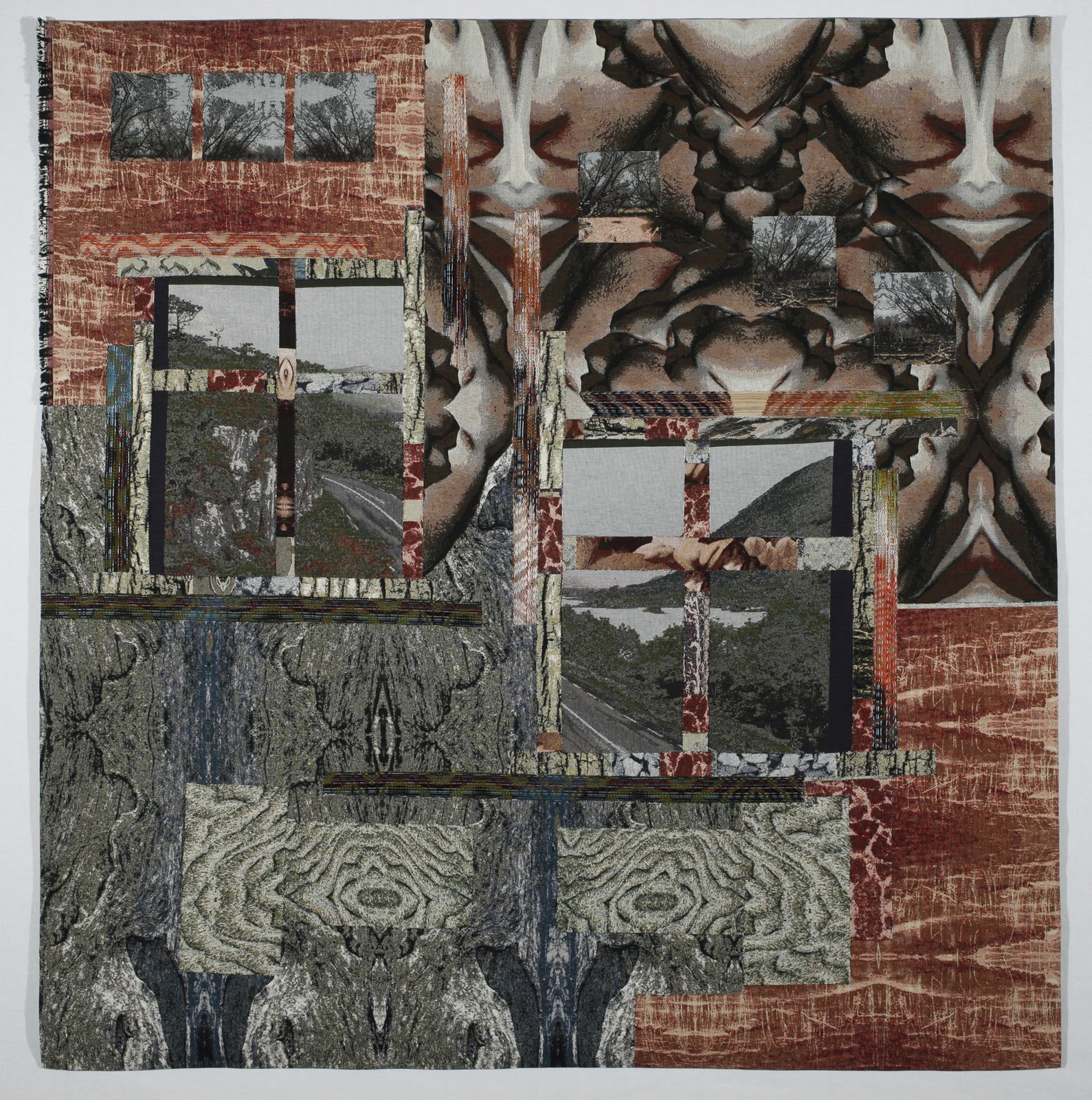

“Of all the possible pathways of disorder, nature favors just a few… Nature constrains the shape of things.”
(Gleick, 1987)
In school I was taught that the universe has a natural tendency to move towards disorder and chaos. I had trouble understanding this statement since I was surrounded by a world of structure and pattern. While our world is in a constant state of flux, people take comfort in routine and predictability. This routine is constantly bombarded by outside influences, making it difficult to maintain. The seemingly minor choices made on a daily basis can have major impacts on our lives given the passage of time. Our lives are filled with chance occurrences that can alter the paths we take and create. Scientists are learning that there is an order to chance. Nature relies on chance to produce evolution.
My work alludes to these evolutionary forces and the way they control the form, structure, and patterns of our world. I am intrigued by the fact that the forces that shape rivers, produce stripes on tigers, and control the formation of snowflakes are the same forces that shape political, economic, and social systems. I utilize a variety of textile techniques that exhibit the same type of chance occurrences that occur in nature. I use technical process to talk about physical process. I combine hand-woven and industrial-woven (jacquard) fabrics. The row-by-row act of weaving creates images that are revealed over time. This is analogous to the day-by-day manner in which we live our lives. Time and history reveal patterns that are not apparent in the moment. Fragmentation and recombination of multiple images creates a sense of constant change and a system in flux. I employ a variety of techniques to allude to the dynamic ever-changing energy associated with change and evolution.
To design the jacquard fabrics, I begin with digital photographs of images from my life – patterns found in nature, travels in other countries, and friends. These are combined, manipulated, and repeated on the computer. Final designs are adapted to be woven on computerized jacquard looms at commercial textile mills. I also incorporate hand-dyed and hand-woven fabrics. Utilizing complex weave structures, I try to produce patterns that defy the inherent grid structure and appear more organic than traditionally woven cloth. All of these fabrics are cut and pieced back together to produce large-scale fabric collages. Pieces have batting, backing, and are machine-quilted.
By using repetition, mathematical progression, and simple pattern, I can appeal to the viewer’s innate sense of order – the search for underlying order, unity, and the search for understanding. The splitting and recombining of images encourages the viewer to simultaneously combine the parts into a unified visual whole while trying to isolate the constituent parts. I aim for images that are energetic and open to interpretation without being merely confusing. The result is similar to the tension created when one is on the verge of solving a puzzle. The solution is in sight but not yet attained. By combining these visual images into a unified whole, I hope to convey the universal nature of these physical processes. https://davidbrackett.net
- University of Kansas, Master of Fine Arts in Textiles, with Honors
- University of Michigan, School of Art Concentration: Weaving & Fabric Design and Art History
- University of Michigan, College of Literature, Science and the Arts Bachelor of Science; Concentration: Zoology
Associate Professor University of Kansas Department of Visual Art https://ku.edu

 NAFTAE