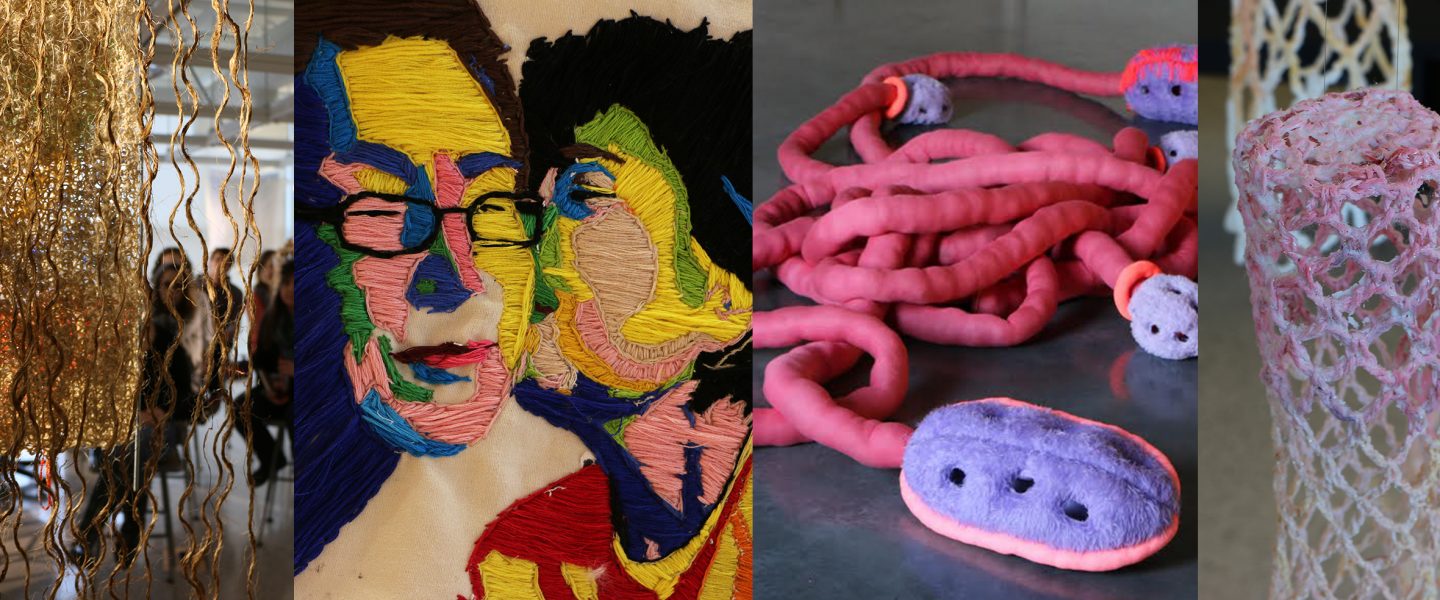

Jovencio de la Paz is an artist, writer, and educator. His work explores the intersection of textile processes such as weaving, dye, and stitchwork as they relate to broader concerns of language, histories of colonization, migrancy, ancient technology, and speculative futures. Interested in the ways transient or ephemeral experiences are embodied in material, de la Paz looks to how knowledge and experiences are transmitted through society in space and time, whether semiotically by language or haptically by made things. He is currently Assistant Professor and Curricular Head of Fibers at the University of Oregon.
Jovencio de la Paz received a Masters of Fine Art in Fibers from the Cranbrook Academy of Art (2012) and a Bachelors of Fine Art in Fiber and Material Studies from the School of the Art Institute of Chicago (2008). He has exhibited work in solo and group exhibitions both nationally and internationally, most recently at The Museum of Contemporary Art in Denver, Colorado; Ditch Projects, Springfield, OR; ThreeWalls, Chicago, IL; The Museum of Contemporary Craft, Portland, OR; The Alice, Seattle, WA; Carl & Sloan Contemporary Art, Portland, OR; 4th Ward Projects, Chicago, IL; SPACE Gallery, Portland, ME; The Sculpture Center, Cleveland, OH; SOIL Gallery, Seattle, WA; Roots & Culture Contemporary Art Center, Chicago; The Hyde Park Art Center, Chicago; Uri Gallery, Seoul, South Korea, among others. He regularly teaches at schools of art, craft, and design throughout the country, including the Ox Bow School of Art in Saugatuck, Michigan, the Haystack Mountain School of Craft in Deer Isle, Maine, and the Arrowmont School of Craft in Tennessee. He is also a co-founder of the collaborative group Craft Mystery Cult, established in 2010.


As in summer, so too in winter. This work comprises an accumulation of overshot textiles layered precariously on the gallery wall. Colonial American Overshot is a technique of weaving associated with American domestic idealism and Americana in general. Modular in nature, these discrete panels were sampled from an archive of overshot textiles, woven by the artist over a period spanning from 2008 – 2017. Seeing a wide resurgence in popular interior design in the West, this tradition of weaving also evokes an era in which the colonization of the Indigenous west was pervasive. The works consider the uncertain or even duplicitous status of cloth, often occupying a contested and fluid space between utility, artefact, image, structure, crafted thing, and transmitter of conflicted histories.
Weave-draft Aberrations (Compound Twill). A “weave-draft” is a visual instruction used to describe how to prepare a floor loom to weave a specific pattern, but also how to operate the loom to generate that pattern. In this way, designers and weavers can record patterns to be archived or shared at a later date. In the series of videos Weave-draft Aberrations, typical weave-drafts for Jacquard woven textiles have been overlaid on top of each other. The outcome is a moiré, a distortion pattern of interference, completely alien and unlike the source weave- drafts. As the drafts move across each other and across the screen, what is revealed is a new, secret pattern, an undulating series of schizoid but rhythmic chain of events. The process of repurposing the weave-draft skews the instructions away from the production of a physical cloth, directing it towards the weaving of a digital, disembodied textile. http://www.jovenciodelapaz.org
- Masters of Fine Art in Fibers from the Cranbrook Academy of Art
- Bachelors of Fine Art in Fiber and Material Studies from the School of the Art Institute of Chicago
Assistant Professor Art University of Oregon jovencio@uoregon.edu

 NAFTAE